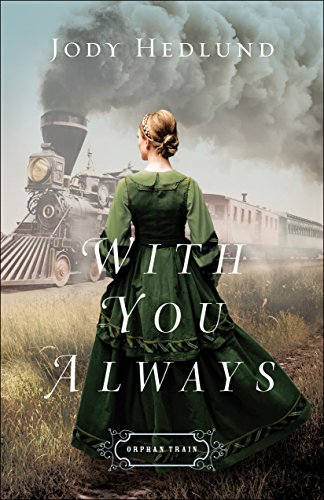
I am thrilled to share a recent interview with author Jody Hedlund today. And....I am giving away one copy of Together Forever to one lucky reader. In order to win, you must live in the United States.
1. What is the inspiration behind your
orphan train series?
 I have long been
fascinated by the era of the
I have long been
fascinated by the era of the
Orphan Trains and the heart-wrenching stories of
the homeless and helpless young orphans that were taken from the streets of New
York City and other eastern cities and shipped west by the dozens. I was
familiar with stories of those scared orphans who were placed out in what was
thought to be a more wholesome, healthy environment of the newly settled
Mid-Western states. Some of the orphans found happy endings and were adopted
into loving families. Others experienced great abuse and heartache in their new
homes.
While stories of
the orphans who rode the trains have been told—and rightly so—the stories of
the women who were involved in the movement are not as well known. One of the
things I particularly like to do when telling my stories, is focus on women who
have been overlooked by the pages of history. I consider it a great privilege
to be able to bring forgotten women to life for our modern generation. Thus,
throughout this series, I’ll be focusing each book on a different aspect of the
Orphan Train movement, particularly from the perspective of women who
experienced riding the trains in one form or another.
2. How did
you come up with the idea for the second book in the series, Together Forever?
Since the first
book in the series centers around the jobless and homeless adult women who rode
the orphan trains, I decided for this second book to show the orphan train
experience through the eyes of placing agents who worked for the Children’s Aid
Society.

The Children’s Aid Society (CAS), started by Charles Loring Brace,
was the major placing organization of orphans in New York City from its
inception in 1853 well into the twentieth century. CAS hired numerous
ministers, single men and women, as well as married couples, to escort orphans
from the east to their new homes in the west. The agents spent weeks and months on the
road caring for the children, all the while trying to place them in loving
homes.
Thus the main characters for Together Forever take on the role of the placing agents, giving
readers a glimpse into the lives of these dedicated men and women who wanted to
make a difference to the many homeless children living on the streets of NYC.
3. What special research did you do in writing Together Forever?
In researching the roles of CAS placing
agents, I came across one of the most well known placing agents, Clara B.
Comstock, who traveled west with children from 1911 to 1928. During her years
as a placing agent, she made seventy-four trips and wrote about her
experiences.
I drew from her notes about what it
was like before the trip, the clothes the orphans were given, to the detailed
lists of supplies and food she packed. She also spoke of what it was like
during the journey west along with what happened once they arrived at their
destinations, including an incident where she was quarantined with a young five
year old boy who contracted diphtheria.
At the end of her life, Clara Comstock
said this about her experiences: “The work was a great adventure in Faith. We
were always helped and grew to expect kindness, deep interest and assistance
everywhere. A sense of responsibility was keenly felt by all the workers. My
life has been greatly enriched by the varied experiences found in everything
the Children’s Aid Society and the contacts made. It is an honor to have
followed from afar, the founder of this work.”
4. Usually readers are more sympathetic to the orphans and less
forgiving of the charity organizations who placed the orphans in the west. How
do you elicit reader empathy for the placing agents?
In Together Forever, I hoped to portray the struggles that placing
agents felt right along with the struggles of the orphans. I have no doubt what
the orphans experienced was far more emotional and painful; nevertheless, the
job of the placing agent was not an easy one. It consisted of weeks of
demanding traveling, difficulty in placing children, as well as the logistical
challenges in revisiting each child before returning to New York City.
The agents not only faced the ups and
downs of handling such a wide variety of children, but they also faced the
challenges of the job itself. Since nothing had ever before been done like the
placing out, the agents basically had to learn on the job and make up the rules
as they went.
In the early years, record-keeping was
inconsistent, placements irregular, and the screening process non-existent. While
many of the agents meant well and truly cared about providing better lives for
the children in their care, the lack of consistent practices provided further
hardships to many orphans. Overall, I hope readers are able to gain a better
appreciation for the well-meaning efforts, even if things didn’t always turn
out the way everyone wanted.
5. You make the conditions of New York City and the orphans sound
so bleak. Was it really as bad as you portray in your books?
It’s hard to believe, but an estimated 30,000
homeless children really did roam the dirty city streets and alleys of New York
City in the 1850’s.
30,000. Children. Let that sink in for a minute.
That’s the size of a town.
Historians
look back on that time and try to make sense what led to such horrific
conditions for children. The influx of immigrants was at an all time high. The financial
disaster of 1857 caused even more problems. Jobs and housing were scarce.
Diseases were rampant. Hunger and poverty became a norm.
6. What do
you hope readers take away from Together
Forever?
I pray that in reading this story, not
only will readers gain greater insights and a different perspective of the
orphan train movement, but that they will also be encouraged to know God is
present in their weakest moments.
He doesn’t necessarily promise to give
us the courage of a lion or to make everything perfect. But He does promise
that His strength is available and that His power will rest upon us. Perhaps
that strength will be just enough to get out of bed for another difficult day.
Or perhaps it will be just enough to face the illness or hurt or heartache we
bear.
We can rest assured it will always be
just enough. His strength is made perfect in our weakness.
Personal Q & A
7.
How do you decide on names for all your characters?
The process of coming up with names is quite complicated, and I generally
take a lot of elements into consideration. I keep a running list of all the
heroes and heroines of my books and try not to duplicate anything too closely
to a name I've already used. I also take into consideration names used doing
the time period and the ethnicity of my characters. For example, in the orphan
train series, I chose German names that were commonly used during the 1800's
for my heroines since they’re from Germany. Sometimes I consider symbolism for
names. Other times, particularly in my inspired-by-stories, I try to pick a
name that is similar to the character from history that I'm portraying.
8. What is your favorite part of
the writing process? Your least favorite?
As a writer, I love
telling stories. I especially like the feeling that comes as I near the end of
the book when everything looks hopeless, the characters are in big trouble, and
somehow I’m able to wrap up the book in a satisfying way. I call it the first-draft
love affair! I fall absolutely and madly in love with the story and think it’s
the best thing I’ve ever written.
I struggle the most during
the editing phase of each of my books. The love affair that started during the
first draft comes to an end. I fall out of love with my books. By the last
edit—called the Galley Review—I finally reach a point where I loathe the book,
think it’s the worst thing I’ve ever written, and wish I could just throw it
away.
9. Do you
have any writing quirks?
I don't have too many quirks, other than needing a cup of coffee on hand
while I'm writing (especially in the morning!).
One of the things I like to do to help me keep on track with my writing
is give myself half hour word count challenges–a specific goal of how many
words I can get written in a thirty minute time span. Doing these
mini-challenges keeps me from getting too distracted by other things while I'm
in a writing mode.
10. Is there a Scripture verse that has inspired
you in your writing?
Among many,
here’s one I aspire to live by: Whatever your hand finds to do, do it with all
your might. (Ecc. 9:10) I believe in working responsibly and hard with the
gifts we’ve been given.
11. What advice do you have for anyone interested
in writing and pursuing publication?
Write
a couple of books first and unleash your creativity. Then start reading books
that explain how to write. Study techniques, practice them, and keep writing.
When you begin reaching a level in your writing where you think you’re ready
for publication, get a critique partner or two to read your work and give you
feedback, vamp up your online presence, and immerse yourself in the writing
industry by learning all you can about traditional and self-publication. Don’t
rush into either! Make sure your writing craft and story-telling skills are
ready first.
12. Together Forever is the second book
you’ve released in 2018. How many other books are slated for publication this
year?
This
year, I’ll have a total of four books releasing. The first book, A Loyal Heart,
released in March. It’s part of my young adult medieval romance series that
started several years ago. I’ll be finishing this particular series with a final
book in the fall.

Then
in addition to Together
Forever, the next book in the orphan train series, Searching For You, releases in
December. The original plan for publication was next June, but when my
publisher asked if I could turn it in for an earlier release, I decided why
not? Then readers won’t have to wait quite as long to find out what happens
next!
13. What are you
working on next?
I’m
in the editing phase of the third and final book in the orphan train series, Searching For You,
which releases in December. It wraps up the story of the Neumann sisters by
finally giving long-lost Sophie her happily-ever-after. I don’t want to give
too much away, but I can tell you that Reinhold Weiss also has a major role in
helping Sophie as she struggles to make a new life for herself.
14.
Do you have any parting words?
I love hearing from readers! Make sure you stop by one of
these places and say hello!
I hang out on Facebook here: Author Jody Hedlund
I also love to chat on Twitter: @JodyHedlund
My home base is at my website: jodyhedlund.com
Find me on Instagram: instagram.com/jodyhedlund/
Come pin with me on Pinterest: pinterest.com/jodyhedlund/pins/
To be entered to win your own copy of Better Together, leave a comment about why you want to read Jody's book.